Showing posts with label balanced dog training article. Show all posts

Monday, April 4, 2016

Tug - Should I or Shouldn't I? Dog Training Milton Ontario


Lots and lots of mis-information out there on the internet and in books in regards to the game of TUG with your dog. You will hear a lot of "No, don't do it! It creates ..." and a list of bad behaviours follow this mantra. Many are afraid of letting their dog play because upon seeing all of the "red flags" in print, they believe it will contribute to inappropriate behaviour, over excitement, aggression etc.

The key with TUG is to play the game properly, incorporate rules, exercise, training and fun. TUG is an absolutely wonderful to expend energy - both mind and body. It's a fantastic rainy day game because you can play it anywhere, and is a great way to actually increase self control and focus.

I'm going to briefly go over how you can utilize tug in your dogs training, exercise and in teaching self control. However, not all dogs are motivated by tug toys, or even toys in general. It is not necessary to force the game on to a dog that doesn't enjoy it, however, you can build drive for the toy in a dog who is unsure or under confident. I've had much success in building drive for the game by letting the insecure dog win, making it non-threatening (getting down on the dogs level, no hard pulls), very active and interactive (making the toy "come to life") and building upon success with lots of praise and some fetch and teasing thrown in. There is absolutely nothing wrong with letting your dog win at times, especially when trying to build confidence. *Make sure to tug low, and don't bounce your dog all around when you do it. Light side to side movement on their level to start. You can be more aggressive with movement when working with established dogs, but be safe and don't cause injury by crazy movements or flailing your arms around like a maniac.

We do teach tug with some rules once we established a bit of drive for the game:
And please note, when you start to teach this game, you need to start in a low distraction environment so that the dog can focus. Don't think that you can teach your dog how to tug correctly in the middle of the park with 100 children and dogs running around. Be fair.

1. We start the game and we end the game, period. I firmly believe that giving into a pushy dog who is constantly harassing you to play, leads to other issues that increase that demanding behaviour in other aspects of life. So if you have a dog who is always pushing the toy at you, putting it in your lap, barking at you to play, put the toy away, and when you are ready, then you can engage. However, if you are mid-play and the dog is coming back at you hard for more, of course you can still engage, but once you say game over, it's done.

2. Build a release mark - the mark is to let the dog know they've done the right thing and a reward is coming. I prefer to use OK, however you can choose any short word that works for you (done, free, break, yes). Use the release mark just before re-engaging. OK and go back to tugging.
Build a duration mark - to let the dog know to keep doing what they are doing. GOOD for example tell my dogs keep it up. This is once we start to work on longer periods of self control and/or the addtion of obedience to the game.

3. Once we have drive, we need to teach the dog a clear OUT of GIVE. This is releasing the toy when asked. There is three different ways we teach the OUT. 
  • My favorite way, that works for most dogs, is making the toy "go dead". The key with this is to hold the toy against your leg with both hands (collecting the "loose ends" so to speak"), so the dog can not get the bounce/pull out of the toy, and at this point its boring - most dogs let go if it's boring. The moment, and in the beginning it is exactly the moment, that they let go, mark with your release work (OK) and immediately re-engage. The reward for the release is the game.
  • For owners who are having issues with making the toy dead, or for the dogs who just won't give up, we can offer a food trade. This isn't my favorite way to teach a highly food motivated dog as sometimes they prefer the food over the toy, and that reduces the drive for the game, however it can be useful in the beginning when teaching to get the dog to understand the word, and then quickly fade the food out so that the game, once again, becomes the reward.
  • The last method, and not one that I use often, is the collar pressure method. I reserve this for dogs who have VERY firm grips and won't let go for anything - don't care about he food, don't care that the toy is dead, and all contact with the toy is rewarding. Straight upward pressure on the collar (usually a flat or martingale) will entice the dog to spit the toy out - the reward is immediate re-engagement.
Keep in mind, there are no perfect dogs, so they will all make the mistake of not giving it up right away at times, just be clear and consistent in the fact that there is no more game if you don't give it up. Don't try to pull the toy out of your dogs mouth, this just makes it more fun to hand on.
Once the OUT or GIVE has been taught, we can start to ask for some self control from the dog but not immediately re-engaging once the dog OUT's. So we increase the wait time between the OUT and the game, creating a dog who, even though is aroused, must control himself in order to play again.You can utilize the duration mark (GOOD) when building that time between the OUT and the game.

4. Once we've established an out, don't over use it. The more you use it, the less fun game becomes for those new to tug.

5. The dog should NEVER be allowed to self reward with the tug if you want to build drive for the game. Meaning, the dog isn't allowed to run away and chew on the tug or play with it on her own. We want the game to be rewarding with YOU not without you. So if in doubt, get a separate toy for tugging rather than one that the dog has with them or free access to all of the time. This helps to build desire to be with, focus on and work with you.

6. When the dog is excited about the game, the drive is evident, the dog is aware of your above rules, is able to control herself after the OUT, and is happy playing for periods of time, you can start to add the TUG game as a reward for obedience behaviours. And this is where we can start to work the self control aspect even more. After an OUT, I do not always return immediately to the game. I can ask for any number of behaviours before re-engaging. I keep it to a singular behaviour when the dog is is first learning that response to a command means re-engagement. I typically start with SIT or LOOK, and I don't make the dog hold it for extended periods to start. SIT or LOOK for a couple seconds is good enough in the beginning and you can increase time as the dog learns. The reason that we start very short is to build upon success. If you wait too long, and you have a very driven dog, your dog will fail, break the SIT or break eye contact and try to go for the tug. Start small, and work your way up as your dog is learning. Make sure to use your duration mark (GOOD) when the dog is holding a position. Make sure that the dog is never rewarded before we release (your reward mark - OK). If the dog is catching on, and is showing control for longer periods, if they break their position, we can remind with a NO or ARGH, and
re-set them. If the dog gets really pushy at any time, and you feel frustrated or feel that the dog isn't following the rules, END THE GAME and try again later or the next day.

So we now have a dog who understands that being demanding will not get him the game, we have established drive for the game and marker words, a clear OUT but and OUT that you are not overusing, some self control and reward for obedience skills. We can now take this game and use it as reward for bigger skills, for focus in more distracting environments, and of course, for dog sports.

I can tire a dog out more with a 10-20 minute game of tug (time depending on the dog) with obedience and self control thrown in, than with a 20-30 minute walk. As I mentioned, it's a great rainy day exercise, and if you are working on building some foundation in dog sports, it is a critical skill to have.

So have fun with your dogs, build upon success, build their focus and enhance your relationship with this easy, beneficial game.


Sunday, July 22, 2012

Why Balanced Dog Training? Dog Trainer in Milton and Burlington

There are many different methods from many different dog trainers in this world and many conflicting ideas of what is best for our canine companions when it comes to training. Everything from purely positive to complusion only training, and the mix left inbetween.

As a general rule, dogs will respond differently to different people, to different objects, to different training methods, in different situations. Dogs are not robots, dogs are not pre-programed and dogs are not idiots.

It is best not to be close minded about training our dogs, as it reduces training to a "this or nothing" type of approach that, in training, and life in general, is not ideal.

Balanced training offers the best of both worlds - positive motivation paired with corrective training, that usually garners the most reliable results.

I've included a few links below for those interested in looking deeper into the world of balanced training, why it works, and why we shouldn't be close minded to our dogs intellectual needs.

Plan B - Kill the Dog - by Roger Hild

Calm and Assertive Clicker Training - by Terrierman - Patrick Burns

A Silent Killer - by Tyler Muto

Real Training vs Operant Conditioning - by Roger Hild

Most people live real lives, with jobs, children, households and other activities to take care of. They don't have the time to spend 40 hours a week conterconditioning their dog to garner the results of postive only training, nor do they want to punish their dogs into oblivian with complusion only training. A balance is needed in order to get results that are more reliable and speedier than either of the above mentioned methods.

Life carries with it both positive and negative consequences. Consequences teach us rights and wrongs, we learn from consequences daily and they will drive us to change our behaviour the next time around. Shouldn't we allow our dogs to learn at their full potential, in a natural way that has been working for millions of years?

Monday, July 16, 2012

Motivators and Training - Dog Trainer in Burlington and Milton


There are a number of different motivators that we can use when training our dogs. Motivators are the driving force that makes the dog want to work for us. In sport dog training, a dog with high drive for food, play or prey, makes treats, toys and tugs excellent motivators for performance. These motivators tend to keep these dogs "in drive" meaning that you are going to get a quick, intense, upbeat, flashy performance utilizing these tools. Corrections, voice, touch, play and social interaction are also motivators, but on a bit of a different level. Pairing different motivators together is what gives us reliable results both in the performance arena, at home, or where ever you and your dog may be.

Sometimes though, the motivator is too much for the dog to handle, and you're left with a sloppy, excited mess at the end of the leash. And it is not just the use of food that entices this intense behaviour. There are many dogs who are extremely motivated by touch and social interaction, that fall apart completely when their owners give them a rousing "good boy!!! oh such a good boy!!!". Timing and self control also become an issue when the motivator is so highly coveted that the dog becomes giddy thinking about it.

The key to utilizing the motivator is feel out the intensity used by the owner to deliver that reward, be it treats, praise, tugs etc. It is also our job as trainers to determine what works best for each individual dog. If you have a dog that is nuts for balls, but will work for a treat reward or praise, use the treat or voice instead of the ball to tone down the energy level until the dog has built up enough self control to work for the toy that drives them to the edge.

Self control is a whole topic unto it's own, but it is something that is extremely important for dogs to learn, and until your dog learns self control, don't use over-the-top rewards or techniques that cause the dog to "loose their mind". If you get to that point with your dog, he or she is no longer learning because they are so ensconced with the reward that nothing else really matters.

There is also another side to the motivators that causes dogs to lack drive, lack interest and lack the joy of wanting to work for their owners. Usually this comes with the sole use of punishment based training, the incorrect use of voice/petting for reward when training (too much or too little) or the incorrect steps to wean the dog off of the food/toy lure. All of these can reduce the performance in your dog and create unreliable, lackluster results.

Do we really need motivators that put the dog in "drive" for pet dog training? The average dog owner doesn't need a flashy, high energy performance when asking their dog for a down stay on the front lawn. They don't need the dog "in drive" to perform basic obedience commands at home. They don't need to have a dog that displays controlled insanity when asked to sit. They don't want to have to try and control the energy level that comes with certain motivators. Most owners just want reliability, without the intense energy level that can be brought on by certain motivators. This is where we need to take another look at the motivator currently being used and adjust strategies accordingly if your dogs drive for the reward it too high.


Pairing motivators such as treats, voice and corrections together, once the dog understands what is beinig asked, tends to offer a very reliable result, with just enough drive to get quick response, but not enough drive to bring the dog over the edge. Pairing motivators in this way allows trainers to fade the food reward and replace it with voice/praise/petting, so food no loner is relied upon for commands.  As well, pairing guiding corrections can help tone down any incorrect or high intensity responses, let the dog know that he or she needs to comply and give the dog a clearer picture of what is being asked, creating a calmer thought process for the dog.  (There are steps to be taken when utilizing the corrections for obedience training, and the dog needs to understand what we are asking of them before corrections are added in order to be fair to the dog during the learning process.)

Experient with your dog - find out what works by testing different motivators in non-distracting settings to see how your dog responds. If you want to advance your dogs training, are interested in sport training or just want a reliable response from your pet, feel free to contact Smart Dogs Canine Training to help guide you along the way dogtraining101@hotmail.com.


Wednesday, June 27, 2012

Back to Basics ... Dog Trainer in Burlington Ontario

Back to Basics - what does it mean?

Well, typically, when someone says back to basics, there is a flaw in whatever process they were using, and they need to take themselves back to step one and start over in order to fix the issue causing the flaw.

When we encounter issues with our dogs, usually a back to basics approach will give us the leverage to deal with those issues. Often times, issues can be resolved by taking your dog back to step one, meaning re-approach the training process as if the dog were a new pup all over again.

It is usually obvious that control from the owner, and self control on the part of the dog is lacking when we see common behavioural issues such a jumping, mouthing, excessive barking, etc. Teaching your dog self control through obedience is a very important process that all owners should take seriously. Proper obedience training allows owners to gain back control, gives dogs an opportunity to offer a correct behaviour rather than a destructive one, and enforces self control in the dog.

Going back to basics with your dog to resolve issues requires owners and trainers to seriously reconsider the previous approach to training and decipher what when wrong. Sometimes it was moving on with a command too quickly before the dog actually understood what was being asked, sometimes it involved a lack of proofing around real life distractions, other times it was the method itself that was lacking. Taking an honest and serious approach to retraining is needed in order to garner better results the 2nd time around.

So, if you are experiencing issues with your dog, rethink the original training process and be honest with yourself about what went wrong. There is no shame in going back to the drawing board and both you and your dog will be better off for it.


Tuesday, June 26, 2012

No Gentle Leaders please ... Dog Training in Milton

The Gentle Leaders and Halties have never been a choice of mine for dog training (and yes, I have used them correctly in the past with my own dogs so I am speaking from personal experience). I find them fairly useless in regards to actual training and in certain cases, down right cruel. The pressure being applied to the nose and the potential damage that can be caused to the neck if a dog suddenly bolts are enough reason for me never to recommend using them. As well, for many dogs, the constant rubbing at the ground or pawing at them to try and relieve themselves of the device is very disconcerning as a good majority of dogs who wear them, never actually get used to their presense.

It is my personal choice to steer clear of them both for my own dogs and my clients dogs.

Please see the below article from a fellow trainer for a more in-depth look at Gentle Leader and why is is not so gentle:

http://dogsintraining.wordpress.com/2011/03/29/not-so-gentle-leader/#comments

Tuesday, May 22, 2012

I Said STAY! - Milton Ontario Dog Training


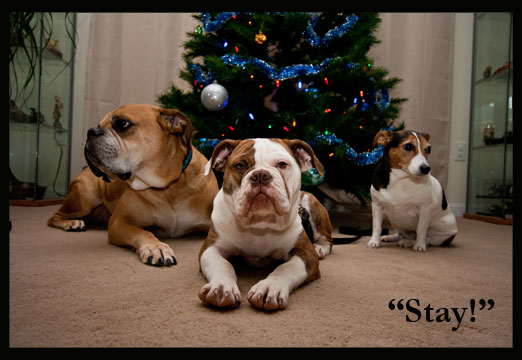
Stay is one of the most important commands a dog can learn, and also one of the hardest for many owners to perfect with their dogs.

Here's a few tips that we've found useful over the years to obtain a better, more reliable stay:

  • Make sure your dog knows what's required, that means practice makes perfect - start in low distraction areas and from there start to build up on duration and distance
  • Once your dog is getting good in low distration, proof your stay in all sorts of locations, different durations and distances (a long line helps with this)
  • Don't try and hold your dog in place with your eyes - that direct stare is very inviting
  • Don't call your dog out of a stay too many times - return more times then recalling from a stay and you won't get that anticipation
  • If you're dog isn't looking at you, who cares, as long as he's holding his position - don't use his name to get his attention back on you, he's most likely going to think you want him to come back to you
  • Once your dog knows what is being asked of him, make sure there is a consequence for breaking the position - a correction and a replacement back to where he was usually suffices
  • Make sure you're using a release command such as "ok" so your dog knows when to move - no release means he can move whenever he feels like it
  • Don't reward half way through the stay and expect your dog to keep holding it - "what's the point", they think, "I already got the reward" - reward after the release

A stay can mean the difference between life or death in certain situations, so having a rock solid stay is extremely important. If you need help training your dog, please feel free to contact us to set up an appointment at dogtraining101@hotmail.com and visit the website to see the classes and private training that we offer www.smartdogsk9.com.

Saturday, May 19, 2012

New training style impacts obedience | Home | Toronto Sun

Interesting article from a professional trainer with over 20 years of experience dealing with every kind of issue dogs can throw at you.

New training style impacts obedience | Home | Toronto Sun

This is not rocket science, but just common sense. Reward and corrections play a critical role in training your dog to be a well behaved member of your family.

Monday, April 2, 2012

New Group Dog Obedience Classes Starting!

Our next group session of Smart Dogs Basic in Milton will be starting on April 18th from 7:15-8:15pm. Session runs for 7 weeks and cost is $180.00. ONLY THREE SPOTS LEFT!

We help you train your dog in all of the basics; sit, down, stand, stay, recall, walk nice, leave it.

The best thing that you can do for your dog is train him/her. It builds a bond with dog and owner, and allows you, the owner, to gain and maintain control, which is extremely important for a happy relationship with your dog.

Contact us today to sign up or visit the website for details dogtraining101@hotmail.com


Tuesday, March 27, 2012

Give Your Dog the Whole Picture - Dog Trainer in Milton

We, at Smart Dogs Canine Training, take the balanced approach to training. For us, meaning that we don't utilize positive only or correction only training, rather a combination of the two.

And there is a reason for this. Dogs learn, as do people, from both positive and negative consequences. If you are only providing feedback from one of the above, you are not providing the student, in this case, the dog, with the full picture.

Of course, we take steps to teach the dogs in a positive manner before corrections are added, but at the point when we are sure the dog understands what we are asking, corrections are added for not responding properly to a command. This ensures that you have a dog that knows you mean what you say. Dogs know when you don't mean it - and they will work that to their advantage.

Remember when training your own dog to give them the full picture, rather than a partial snap shot, and you will end up with a more reliable, well behaved companion.

For more in depth detail on how we train, why not check out one of our classes and see the results for yourself.


Friday, December 9, 2011

It's never too late or too early to train your dog ... Milton Ontario Dog Trainer

There are those out there that will tell you to wait until after a certain age to begin training your puppy, and there are also those out there that still believe that you can't teach an old dog new tricks.

How very wrong they are!!

The best time to start training your dog is from day one. Puppies are like little sponges, and soak up training like a Sham-wow drying a wet car. The key is consistent, short, fun sessions. Though they love to learn and thrive on "mind games" a puppy's attention span is a lot smaller then the attention span of an adult, so keep them interested by keeping the sessions short and happy.

Though older dogs may seem "stuck in their ways", there is no reason to believe that they can not be trainer and/or re-trained in the adult years. The fact is, adults dogs have a greater attention span, and can often be easier to work with in that regard than young pups. Adults who have never been trained should be treated as untrained pups, keep sessions short, consistent and fun to begin with, moving on to more challenges once you see they understand what you want.

Please don't count out the seniors either - they are more than capable of learning new things, the process might be a little longer, but the result is extremely rewarding.

So remember, it's never too late or too early to start training your dog. If you need help or guidance, give us a call or email and we can help you on your way to having a well behaved, trained and happy dog, regardless of age.

www.smartdogsk9.com

Sunday, June 5, 2011

Correct or Ignore? Milton Ontario Dog Training


I am a huge proponent of positive reinforcement dog training. I think you can accomplish great things with this type of training, however, there are downsides to the positive only training that is highly popular right now.

Many people who work exclusively with treats and/or toys do not know how to properly fade out the reward, and there for create a dog who will only work for a bribe or when food is present. A good number of owners end up with an "I won't do it unless you show me the cookie" type dog, because proper fading techniques were not taught. Constantly shoving treats in your dogs mouth every time she does something you ask instead of also utilizing praise and petting as a reward can cause this to happen.

Another down fall is that all meaningful negative consequences are removed from training. This means that there are no corrections utilized to help the dog improve their behaviour. Some will tell you that ignoring the dog during an inappropriate reaction is just as good and will garner the same result as administering a well timed correction. Though this may ring true for some dogs, or some situations, it does not ring true with all dogs during all situations.

For example, if your dog loves to chase squirrels while you are trying to walk him, and loves that more than anything, ignoring him will not make even the slightest difference in that behaviour. Often times a redirect is suggested, utilizing a toy or treat, however, if squirrels are your dogs favorite thing above all else, a redirect on it's own will also not put a dent in this inappropriate behaviour. A correct and redirect, balancing the approach with a negative consequence for the wrong behaviour and a positive consequence when the dog focuses back on you, will offer the most effective solution.

There is also the problem with dogs who are high drive (meaning they are, hmm, how shall I put it, insane about certain rewards ie. food, toys etc.) staying in that state when solely utilizing a source of major excitement as a reward. Some trainers will tell you that it's rare to come across a pet dog that is high drive .... I disagree. Training these dogs in drive, with no consequences can create over excitement, over stimulation and over action. This type of training is fantastic when you are looking for a sport dog, a dog that you want "on" all the time during training. But when you are just looking for a well behaved pet, who can compose herself in public, and not be super excited all of the time, then other methods need to be investigated in order to decrease the drives in those wonderfully crazy, high-drive pets, and utilizing voice and petting as a reward as well as adding some appropriate corrections will help owners reduce the insanity that is high drive.

In the pure positive world of dog training, where ignoring the bad and rewarding the good is your only option, there lies a problem of balance in the method. The problem of doing away with any corrective measure is that you are decreasing the amount of tools that you can use during training, and in decreasing these tools you end up with a dog that can never fully realize its potential. Balance is the key during any training, and allows effective and fair communication when done correctly.

Of course, there are steps to take before any corrections should be introduced during formal training. A dog should be taught in a gentle manner what she is suppose to accomplish. A lure and reward, a clicker session, a physical manipulation can all show the dog in a fair manner what you are expecting. The key is to teach before correcting. You want to be sure that your dog is well aware of what is required before adding a corrective consequence during training. You don't teach a child how to read by spanking them, so don't expect to teach a dog who to sit by popping them on the leash.

That being said, there are certain canine behaviours that require corrective consequences without teaching, such as lunging at other dogs on a walk, constant pulling on the leash, inappropriate jumping, humping and bumping etc. These are what I like to call natural behaviours, that occur without training, and can require a correction to reduce the natural tendencies without teaching anything first.

As stated in the first paragraph, sometimes ignoring an inappropriate action from your dog will provide an excellent result, this is an option that should also not be discarded. During agility competitions, there are no physical corrections, but if your dog has deliberately brushed off your commands, ignoring her after the run, and going straight to crate time instead of receiving her highly coveted tug or treat will, in many cases, make the dog think twice about being sassy. A high drive dog who adores the reward will work harder, and better next time in order to receive that reward - no physical correction needed.

Utilizing any corrections must be timed properly, fairly applied and be appropriate for the situation. Once you have achieved success repetitively in your training while teaching the dog what it is you require, you can add in appropriate corrections for the dog brushing you off when he surely knows the command. If you are sure your dog now know the word "sit", and she deliberately ignores your directive, a minor leash pop, a voice reprimand or a physical touch/manipulation to get them into position is fair. And please note, when I say physical touch I mean an attention grabbing tap, not a kick, hit, punch or otherwise abusive behaviour.

Please do not think badly of yourself if your dog needs to be corrected. There are so many ways to train and get your point across to your canine companion, and really, there is no right or wrong way (unless it is abusive), so keep your mind open to all options during training, especially if you get "stuck" and need to search your trainers tool box for a different method.

If you are unsure of of how to reward or correct properly or would like some guidance on the topic, please contact a professional in your area. Someone you are comfortable with, and someone who is willing to utilize different methods in order to get the results that you are looking for.